Exploring the Learning Process
As part of the project “Teacher Education Infrastructure with a Pilot School Based on Universal Design Principles”, modern technological and research equipment will be acquired, funded by the European Union Funds for 2021–2027 and the state budget of the Republic of Lithuania. The investments are aimed at developing the infrastructure of the consolidated Centre for Teacher Education, improving the quality of teacher education and the training of educational support specialists, advancing educational research, and developing and testing innovative educational solutions.
The project will establish advanced research and study infrastructure comprising a KTU pilot gymnasium, the Laboratory for Narrative Data Analysis and Cognitive Processes, the KTU GazeLab Eye-Tracking Laboratory, the STEAM Educational Solutions Prototyping Laboratory, the MapLab Learning Analytics Prototyping Laboratory, and a multifunctional learning space.
These facilities will support advanced educational research, the development and testing of innovative educational solutions, and the exploration of applications of AI, educational neuroscience, STEAM, learning analytics, and educational technologies, contributing to modern teacher education and innovation across the education system.
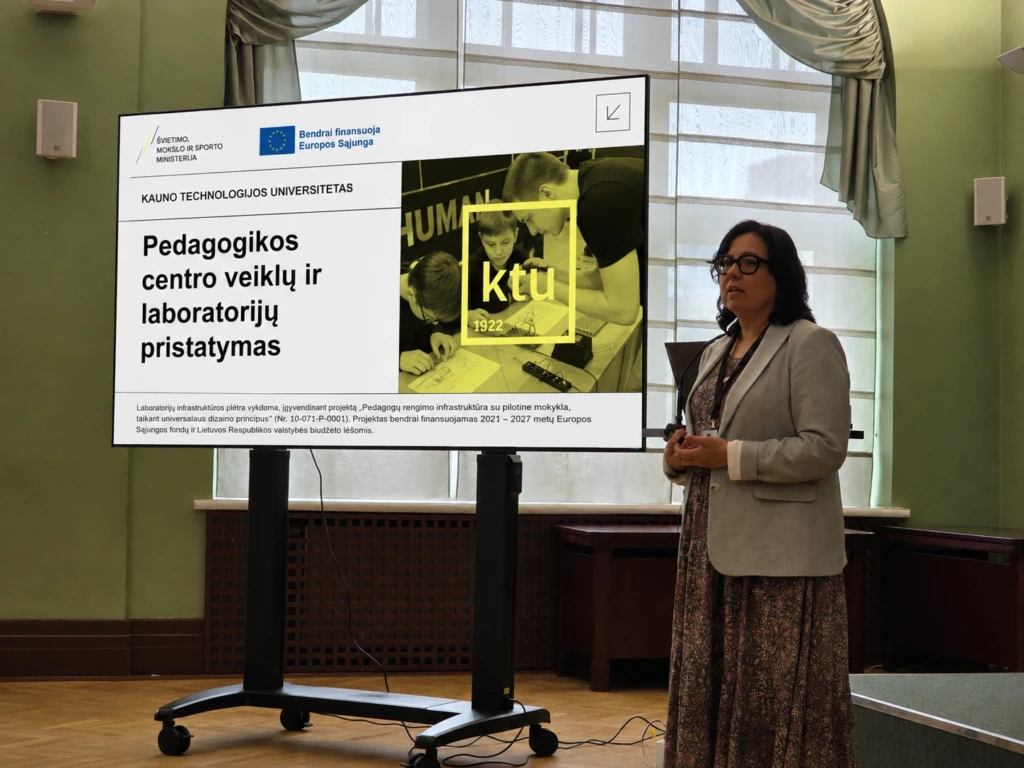
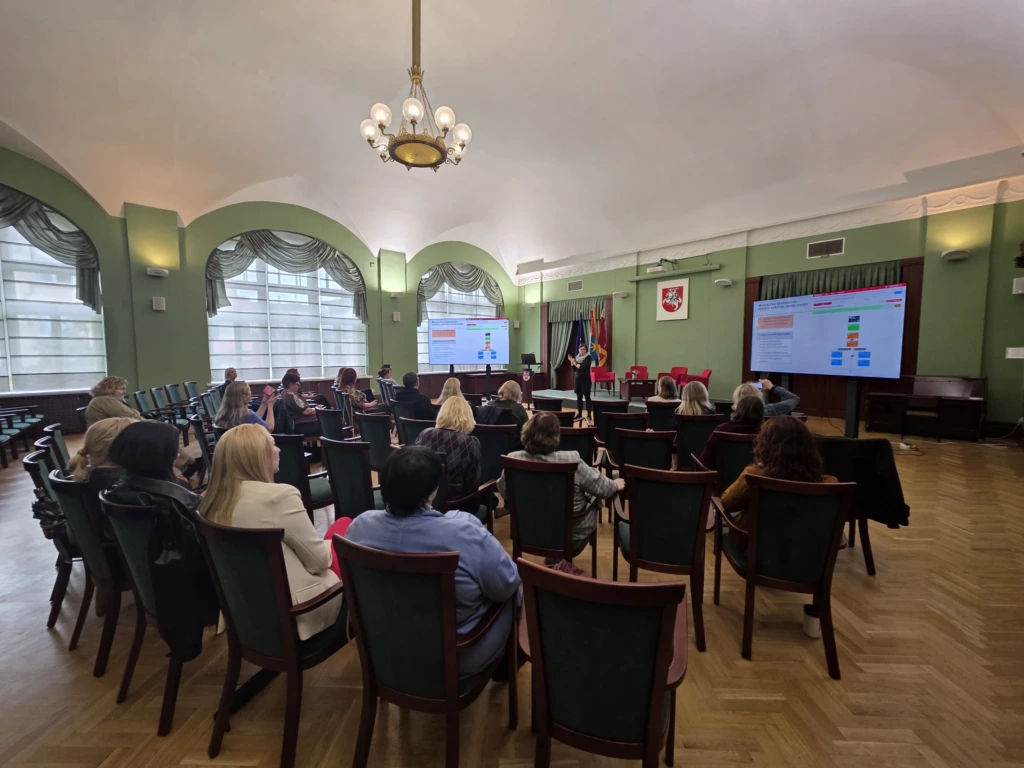
The laboratory presentation session began with Dr. Irina Klizienė, who introduced participants to educational technologies and the activities of the KTU GazeLab Eye-Tracking Laboratory. Using eye-tracking technologies, the laboratory investigates how people perceive information, where they direct their attention, and how learning processes unfold.
Such research provides valuable insights into the effectiveness of learning environments, helps identify learning challenges, and supports the development of evidence-based educational solutions. During the presentation, participants had the opportunity to explore the laboratory’s equipment and its potential applications across various fields of scientific research.
“Eye-tracking technologies allow us to examine the learning process from the student’s perspective. By analysing what students focus on, how they read, solve tasks, or interact with learning materials, we can better understand learning processes and develop more effective educational solutions,” explained Dr. Irina Klizienė.
To further expand its research and study infrastructure, KTU plans to acquire new mobile eye-tracking equipment in the near future. This will enable research to be conducted not only in laboratories but also in authentic learning environments, including schools, university classrooms, and other educational settings. The new equipment will support larger-scale studies and strengthen the laboratory’s capacity to contribute to the development of innovative teaching and learning solutions.
Dr. Laura Daniusevičiūtė-Brazaitė then introduced the Laboratory for Narrative Data Analysis and Cognitive Processes, which will specialise in educational neuroscience and artificial intelligence. The laboratory will investigate human narratives, experiences, and cognitive processes to better understand how learning, professional development, and decision-making take shape. Research will combine qualitative approaches with advanced technology-based methods, enabling a more comprehensive analysis of the relationships between cognitive processes and education and supporting the development of research-based solutions for educational practice.
The event also featured an overview of the research equipment and software being acquired and used by the laboratory. These include SenseMaker software for narrative data collection and analysis, the renewal of the Automated Neuropsychological Assessment Metrics (ANAM) system licence, the renewal of the RealEye remote eye-tracking system licence, and functional near-infrared spectroscopy (fNIRS) equipment. These technologies provide opportunities to investigate cognitive processes, decision-making, attention regulation, and learning experiences across different educational contexts.
When Data Help Improve Learning
The activities of the MapLab Learning Analytics Prototyping Laboratory were presented by Dr. Rasa Erentaitė. The solutions developed in the laboratory enable researchers to analyse both real-time and longitudinal learning data, monitor learning progress, and identify factors that influence educational outcomes.
“Learning data become valuable when they help us better understand learners’ needs, different learning paces, efforts, and motivation. Learning analytics allows us to examine not only learning outcomes but also the learning process itself, particularly in digital learning environments. This enables the development of more personalised and effective learning experiences,” explained Dr. Rasa Erentaitė.
Learning analytics is becoming an increasingly important component of modern education as digital learning solutions become more widespread and national and local educational data infrastructures continue to develop. Research conducted in the laboratory provides valuable insights for developers of digital educational solutions, teachers, and educational institution leaders.
To strengthen the laboratory’s research and experimental capabilities, 30 tablet computers have already been acquired for data collection in various educational environments, along with a high-performance computer designed for analysing and processing large datasets and developing learning analytics prototypes.
This infrastructure will enable advanced data-driven research and the development of innovative solutions for the education sector. Importantly, mobile equipment will allow research to be conducted not only in the laboratory but also in authentic educational environments, such as schools, classrooms, and other settings where learning takes place.
STEAM Education – From Idea to Prototype
The laboratory presentations concluded with Dr. Berita Simonaitienė, who introduced the STEAM Educational Solutions Prototyping and Research Laboratory. The laboratory will focus on developing, testing, and refining innovative educational solutions that integrate science, technology, engineering, arts, and mathematics.
Its activities will focus on advancing subject-specific teaching methodologies, fostering creativity, developing problem-solving skills, and promoting interdisciplinary learning. Through the development and evaluation of new educational approaches, researchers will explore effective ways to engage students in STEAM disciplines and cultivate competencies essential for the future.
A key area of the laboratory’s work will be collaboration with other KTU faculties, bringing together expertise from different disciplines to develop joint educational solutions. This synergy of combined expertise will strengthen STEAM teaching methodologies, advance research-based innovations, and ensure their practical application in educational settings.